
I noticed something while working with AI across Fashwe and Growth by Gill.
The more capable the tools became, the less useful it felt to keep starting from an empty chat.
A lot of AI use still looks like this: explain the business, explain the problem, ask for an answer, copy the result somewhere else. A few days later, start again and repeat half the context.
There is nothing wrong with that. I still use AI that way when the job is genuinely one-off.
But for work that happens repeatedly, better prompting only gets you so far. At some point, the bigger improvement comes from changing the way the work is organised around the AI.
That is the distinction I think matters for businesses now.
A good prompt still starts from zero
Prompting has become a skill in its own right. There are prompt libraries, frameworks, templates and increasingly elaborate ways to tell an AI exactly what you want.
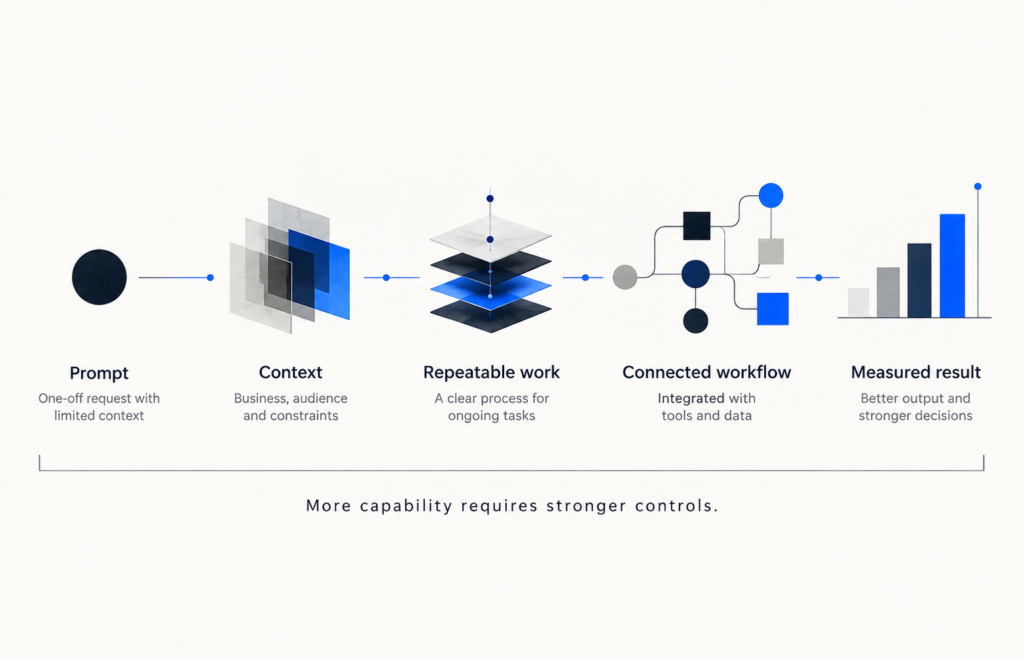
Clear instructions do make a difference.
The problem appears when the same work happens again and again.
Imagine bringing someone into your business and, every time you gave them a task, having to explain what the company does, who the customers are, how the brand communicates, what happened last week and which information they should use.
You would eventually stop improving the instructions and start improving the working environment.
AI should be treated the same way.
If I want help with one Instagram caption, a prompt may be enough. If I want AI involved in how a business plans, creates, reviews and learns from social content every week, the prompt is only one small part of the job.
The business needs context. The work needs a process. Someone needs to decide what the AI can do on its own and where it has to stop.
That is where prompting starts becoming a system.
The tools are already moving in this direction
The technology is starting to reflect this shift.
On 25 August 2026, OpenAI introduced webhook-triggered tasks that can respond to supported activity such as a new Gmail message, a Slack channel message or GitHub pull request activity. The important part is not the webhook itself. It is that a piece of work can now begin because something happened in another system, rather than because someone remembered to open ChatGPT and ask.
Anthropic moved in a similar direction when it launched Claude for Small Business on 13 May 2026. The product connects Claude to tools including Google Workspace, HubSpot, Canva and QuickBooks, with workflows intended for real business tasks rather than isolated chats.
Those products will change. Their interfaces certainly will.
The more interesting change is the behaviour they are enabling. AI is becoming something that can stay closer to the work itself.
That creates more useful possibilities, but it also makes the design of the process more important.
Fashwe made this much clearer for me
Fashwe has been useful because it gives me a real project to work on rather than an imaginary marketing example.
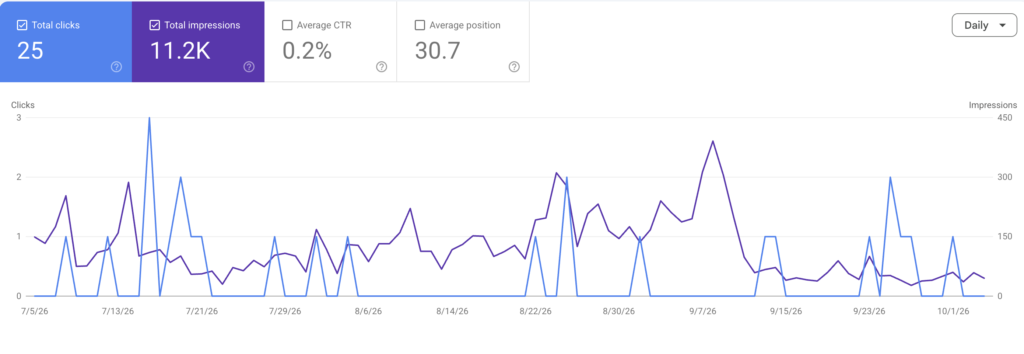
Take Search Console.
When I reviewed the site’s search data, there was no shortage of things I could have changed. Different pages were receiving impressions. Queries were appearing at different positions. Some pages had almost no clicks. There were technical and editorial possibilities everywhere.
The hard part was not finding something to do.
It was deciding what deserved to be done first.
A simplistic AI instruction might be:
Find pages with low clicks and tell me how to improve them.
That sounds sensible until you look at the actual decision.
Low clicks alone do not tell me much. I also care about how many impressions the page is receiving, where it appears in search, what people are searching for, whether the article really satisfies that intent, how relevant the opportunity is to Fashwe and whether the improvement is worth the effort.
Those considerations eventually helped narrow a much larger set of possibilities down to a small number of changes I actually wanted to prioritise.
That is the part I find more interesting than asking AI to produce an SEO recommendation.
The useful role for AI is helping me work through the evidence. The decision still needs a method behind it.
I am going to break the actual Fashwe audit down separately because there is a much more useful lesson in why three changes were prioritised than there is in showing where the Search Console buttons are.
Automation can make a weak process worse
This is the part of the AI conversation I think gets overlooked.
Making something easier to execute does not automatically make it worth doing.
If your content strategy is unclear, automating content creation does not solve the problem.
It creates unclear content faster.
If the business has not decided what makes a useful lead, automating lead research will not suddenly make the targeting good.
If nobody knows which marketing numbers matter, an automated report can still be a bad report. You simply receive it reliably every Monday.
I find this a more useful test than asking whether something can be automated:
If this process ran perfectly every week, would it actually improve the business?
Sometimes the answer will be yes, and AI may remove a lot of repetitive work.
Sometimes the answer exposes a more basic problem. The process itself has not been thought through properly yet.
Automating that process first just makes the weakness less visible.
Giving AI capability does not mean giving it authority
I have run into the same issue while using AI for website development.
AI can make meaningful changes to a codebase now. That does not mean I want an AI system making unrestricted changes to a live website.
With Fashwe, GitHub is the source of truth for the theme code. Changes normally move through branches and review before release. Staging is separated from production, and the production theme is deployed through a separate manual workflow. Not every boundary is technically enforced, so I treat that separation as a process to inspect rather than a guarantee.
The important part for me is the separation.
AI can have enough access to be genuinely useful without having the authority to do anything it wants.
That principle extends well beyond code.
An AI might be capable of drafting an email without needing me. Whether it should send that email is a separate decision.
It might analyse advertising data and recommend changing a budget. That does not automatically mean it should be allowed to spend more money.
It may be capable of producing ten social posts in a few minutes. That does not mean I want it deciding what Growth by Gill believes and publishing those opinions under my name.
As AI systems become more capable, I think businesses will need to become much more deliberate about that distinction.
The question is not simply, “Can AI do this?”
It is also, “How much authority should it have when doing it?”
Start with work that already exists
There is a temptation to work backwards from whichever AI product is getting attention.
You hear about agents, Dots, connected apps or some new automation feature and start looking for something in the business to give it.
I think the better starting point is much less exciting.
Look at work you already repeat.
Maybe every week you review search performance. Perhaps customer emails repeatedly need to be sorted and answered. Maybe the business turns one substantial article into several smaller pieces of content. Perhaps campaign performance needs to be checked and someone has to decide what deserves attention.
Understand how that work happens today before adding AI to it.
Where does the information come from? Which parts are repetitive? Which parts depend on judgment? Where do mistakes matter? What result would actually make the process better?
Only then does the choice of tool become particularly interesting.
In some cases, AI might simply organise the information before you look at it. In others, it may be able to research, compare options or prepare a recommendation. Once a process is well understood, some lower-risk actions may eventually happen automatically.
There is no prize for removing a human from every step.
A useful system should remove work that does not deserve much human attention while protecting the decisions that do.
What I mean when I say “build systems”
I am not talking about creating an elaborate network of agents for every part of a small business.
That would be a very efficient way to overcomplicate things.
For me, a system can be much simpler.
It might mean AI no longer needs the business explained from scratch every time.
It might mean the same information is reviewed in a consistent way.
It might mean a recurring task begins automatically rather than relying on someone remembering it.
It might mean AI prepares the first pass and a person makes the decision.
It might eventually mean some low-risk work happens on its own because the process and its boundaries have already been tested.
The point is not to automate as much as possible.
It is to design the work properly first.
That is also how I want to approach AI through Growth by Gill. I am less interested in collecting clever prompts than in understanding how these tools fit into real businesses, where they save time, where they improve decisions and where giving them more access would be a mistake.
The next part of that is context.
If an AI system barely understands the business it is working for, adding more automation simply gives generic output more reach.
So the next piece will be practical. I am going to build an AI Business Brain that holds the useful context about a company, its customers, offers, positioning, voice, constraints and priorities, without turning the whole thing into one enormous master prompt.