Imagine you run a physiotherapy clinic.
On Monday, you ask AI to draft an email promoting appointments. The copy reads well, but it focuses on sports rehabilitation when that is not what the clinic is trying to grow.
You correct it.
On Tuesday, you ask for new website copy. The AI includes an old consultation price.
Another correction.
On Thursday, you ask for ideas for next month’s marketing. It recommends promoting a service the clinic does not offer.
None of the answers are obviously bad. That is part of the frustration. The AI can produce polished work while still getting important details about the business wrong.
The natural response is to write a better prompt.
So you explain the clinic again. Who it serves. What it offers. What matters right now. How it should sound. What the AI should avoid.
The next answer improves.
Then another task starts, and you find yourself giving the same briefing again.
At some point, prompting is no longer the main problem.
The AI needs a reliable working picture of the business.
A bigger prompt only gets you so far
A common solution is to build a master prompt.
You add your business description, customers, services, tone, goals, prices, examples and rules. That can be useful, particularly when the alternative is giving AI almost no context.
The difficulty comes later.
A temporary priority gets mixed with permanent information about the company. A service changes. An old price stays buried in the prompt. Writing instructions sit next to business facts. Something that was true six months ago quietly remains there.
The document gets longer, but not necessarily more reliable.
A large prompt can carry context. It is not a particularly good system for maintaining business knowledge.
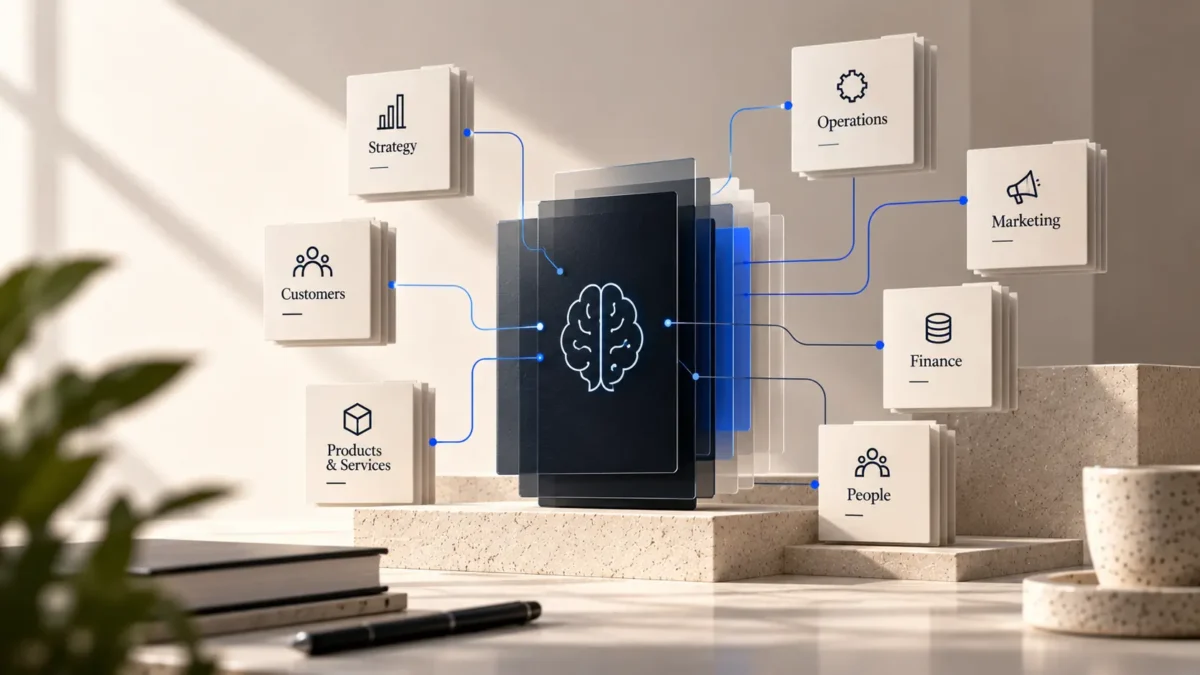
That is where an AI Business Brain becomes useful.
I use that term for the maintained business context AI can draw on when helping with real work. The concept itself is not unique to Growth by Gill. Business Brain templates already exist, and current AI products provide ways to keep reusable files and instructions around ongoing work.
The useful question is not how much information you can give AI.
It is how to organise that information so the AI has a better chance of using the right context for the job.
Four questions are enough to start
I would organise a Business Brain around four questions: what should AI know, where should AI look, how should AI work, and what are we doing today?
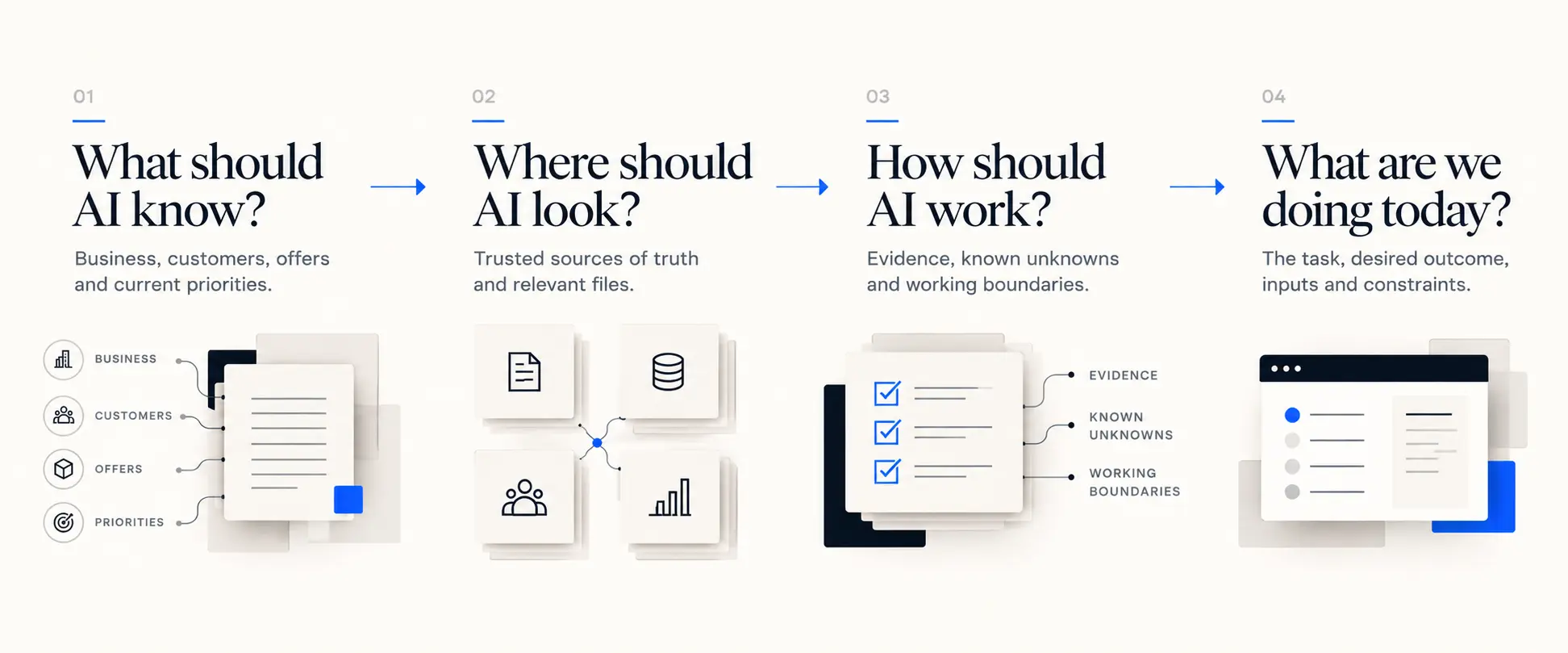
The first three create reusable context. The fourth changes from task to task.
That distinction is important. The goal is not to build one enormous document and paste it into everything.
A Business Brain should make your prompts carry less weight, not more.
Prefer to build yours as you read? Download the Word template or Download the Markdown template
1. What should AI know?
Start with the information you repeatedly find yourself explaining.
For a small business, that will usually include what the business does, who it serves, what it sells, how it is positioned and what matters right now.
The imaginary physio clinic might record that its current growth priority is office workers dealing with recurring neck and back discomfort. It could list the services actually offered, describe the people those services are intended for and explain anything important about how the clinic wants to position itself.
You do not need to document everything the business has ever done.
Include information when it helps AI make a better decision or avoid a mistake you keep correcting.
That is the core Business Brain.
Then something interesting happens as it grows.
2. Where should AI look?
Growth by Gill started with the same basic idea: give AI enough context to understand the business and the work around it.
Over time, the useful material stopped fitting neatly into one document.
There is separate keyword research, editorial and SEO guidance, design documentation, an implementation record from Fashwe and a standing content standard.
I use an Index.md file to tell AI what those files are for. The index does not reproduce their contents. It acts as a map.
That distinction matters.
If I am working on a Growth by Gill article, the keyword research and editorial standards may be important.
If the task is about design, different material becomes relevant.
The AI should not need every document for every task.
It needs a sensible place to start.
OpenAI has described a similar pattern in its own agent engineering. Rather than allowing one large instructions file to become an encyclopedia, its team uses a smaller entry point that directs agents towards deeper documentation and authoritative sources. OpenAI describes the broader approach as progressive disclosure: start with a small, stable entry point, then go deeper where needed.
A small business does not need anything close to that level of engineering.
The useful principle is much simpler.
As your context grows, give AI a map instead of trying to squeeze everything into one file.
The map also needs sources of truth
Organisation alone does not solve conflicting information.
Return to the physio clinic.
The website says:
Initial consultation: $120
The practice-management system says:
Initial consultation: $135
Giving AI both figures does not solve anything unless it knows which one is authoritative.
The Brain might therefore say:
Current service pricing must be checked against the practice-management system. Website pricing may be outdated.
That is a source-of-truth rule.
Growth by Gill already uses this idea in practice. Different systems own different information. Theme and system presentation belong in Git, living website content belongs in WordPress, SEO configuration belongs to the SEO layer, and analytics belongs in GTM and GA4.
The Business Brain does not need to copy all of that information into itself.
Sometimes its job is simply to say:
For this information, look there.
That makes the Brain more maintainable and reduces the chance of an old copy quietly becoming the answer.
3. How should AI work?
Knowing the business is different from knowing how to behave while working on it.
| Type | Example |
|---|---|
| Business knowledge | Growth by Gill focuses on SEO, websites and Google Ads. |
| Working instruction | Do not invent performance statistics. Flag conflicting evidence. |
| Today’s task | Review this service page and identify the three highest-priority improvements. |
Current AI project tools can already separate reusable knowledge from project-level instructions, although the exact features will continue to change. ChatGPT Projects and Claude Projects are two current examples.
The product features will change.
The distinction is more useful than the product.
Tell AI where certainty ends
Working instructions should also cover evidence.
A useful Business Brain does not only record what the business knows. It records what the business does not know.
Growth by Gill’s current keyword research is a good example.
We have identified topics that appear relevant to the audience, but the research does not contain verified Australian monthly search volumes. It explicitly warns against turning unknown demand into zero demand or inventing volume figures.
That means AI can say:
This appears to be a relevant search problem.
It cannot responsibly turn that into:
This keyword gets 1,000 Australian searches each month.
A useful instruction is therefore:
If evidence is missing, say what is unknown rather than filling the gap with an assumption.
This sounds small, but it changes the role of the Brain.
You are not just teaching AI facts.
You are teaching it where the facts stop.
Set boundaries as well as writing rules
A Business Brain may also contain simple operating boundaries.
- do not invent statistics or customer results
- flag conflicting information
- do not publish or send external communications without approval
- do not treat a proposal as completed work
- ask for verification when an important fact cannot be established
These are not technical permissions.
They are working rules.
Deeper questions about what an AI agent should actually be authorised to change, send, buy or publish deserve separate treatment.
For this Guide, the important principle is that knowing something about the business does not automatically give AI permission to act on it.
4. What are we doing today?
A Business Brain does not replace the task brief.
It makes the brief more focused.
Without reusable context, a prompt might spend several paragraphs explaining the business before reaching the actual job.
With a Brain in place, the task can concentrate on what is different today.
For example:
Review the supplied service page and recommend the three changes that would make the offer easier to understand. Use the Business Brain for company context. Check current service information against the nominated source of truth. Flag anything you cannot verify.
The permanent context stays permanent.
The temporary task stays temporary.
That is far easier to maintain than continually rebuilding one master prompt.
Keep one private canonical copy
The Business Brain needs a home, but the choice of file format matters less than keeping one version authoritative.
For many small businesses, a normal document is enough.
Current AI project environments can keep reusable files and instructions alongside ongoing work. For more technical workflows, plain-text or Markdown files can also work well, particularly when the business already uses version-controlled project files.
If you store the Brain in a repository, keep that repository private unless the information is intentionally public.
A Business Brain may contain positioning, internal priorities, evidence notes, commercial decisions and unresolved claims. It should not become public simply because Markdown is convenient.
Whichever format you choose, avoid maintaining several independent copies.
If one version is updated and another is not, you have recreated the same context problem the Brain was supposed to solve.
Keep one version authoritative, maintain it properly, and make that version available where the work happens.
Do not put everything in the Brain
Useful context is not the same as unlimited context.
Passwords, authentication codes, API keys and payment credentials should not be sitting inside a Business Brain.
Customer information, commercially sensitive material and other private data require more judgement. Ask whether the task genuinely needs the information and whether the service handling it is appropriate for that information.
Current Australian Government cyber-security guidance recommends considering what information genuinely needs to be shared with AI, reviewing provider privacy and data practices, checking important AI outputs and maintaining control over significant actions. For AI agents, the guidance also recommends limiting access to what the task actually requires.
Give AI the context and access required for the job, not everything the business possesses.
Start with the smallest useful version
You do not need to build the finished Business Brain before using it.
Start with the four questions.
What should AI know?
- the business and its objective
- the customer
- the offers
- the current priorities
Where should AI look?
- the important sources of truth
- the files or systems AI should consult
- a small index once the number of supporting files justifies one
How should AI work?
- what evidence can support claims
- important known unknowns
- things AI must not assume
- working and approval boundaries
What are we doing today?
- the task
- the desired outcome
- the relevant inputs
- any task-specific constraints
Then use the system.
Pay attention to what you keep correcting.
If AI repeatedly misunderstands the same part of your business, that information may belong in the Brain.
If something changes frequently, it may belong in another source of truth rather than being copied into the Brain.
If an instruction only matters for one job, keep it in that task.
Build the system from real use instead of trying to predict every field you might someday need.
USE THE FRAMEWORK
GBG AI Business Brain Starter Template
I have turned the structure used in this Guide into a starter template you can adapt to your own business. Start with the four questions, use it in real work, then improve it as you discover where your AI still lacks context.
Download the Markdown template
No email address required.
The next time you ask AI to work on your business, the job should not begin with another long explanation of who you are.
Give it somewhere reliable to start.
And as that knowledge grows, give it a map.